


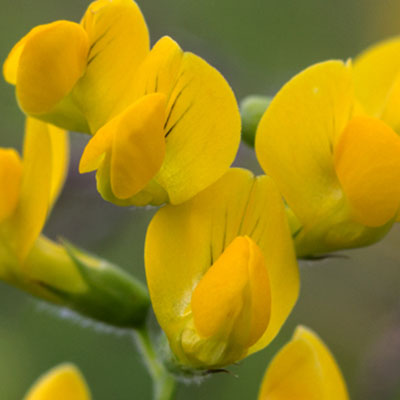
The meadow vetchling (or meadow pea), with its paired leaves ending in a forked tendril and beautiful yellow flowers appearing in long-stalked clusters, is easily distinguished from other vetchlings and pea species. The meadow vetchling has a climbing stalk and reaches for the sky as it grows, clinging to the leaves of other plants. It is a welcome presence in any meadow.
The plants in natural meadows rely on themselves alone to survive, as no one provides them with fertiliser, and the meadow pea has mastered this task remarkably well. It ‘leases’ its roots to nitrogen-fixing bacteria, which attract nitrogen from the air and supply the meadow vetchling with all the necessary nutrients. Nitrogen-fixing bacteria cannot attract nitrogen on their own when they live freely outside plant roots, so they need the meadow vetchling as well. Each year, as a proportion of this plant’s roots die, a portion of the fixed nitrogen is released and becomes available to other plants in the meadow.
The meadow vetchling is found not only in natural meadows and pastures. It has learnt to adapt to life in sown pastures, roadsides, and along fields and forests. A large number of plants from natural meadows have not been as successful in adapting, and these plants — including milkwort, lesser butterfly orchid, maiden pink, shingled gladiolus, and others — are diminishing around us.
Natural meadows and pastures cover only 0.7% of Latvia’s territory, and this area is shrinking further as natural meadows are left unattended or are ploughed, forested, or used for building development.
13.06.2015
Venue: Meadows of the Drusku hill not far from Korneti, Veclaicene parish, Alūksne district.
19.06.2015
Venue: Rūšu meadows, Smārde parish, Engure district not far from the hill “Milzkalna”.
SCIENCE: Solvita Rūsiņa, Agnese Priede
PRODUCER AND SCENOGRAPHER: Roberts Rubīns
MUSIC: Aigars Voitišķis, Andris Sējāns, Ingus Ulmanis, Kaspars Tobis, Reinis Sējāns.

I am an assistant professor at the University of Latvia, Faculty of Geography and Earth Sciences. I teach Biogeography, Field Course in Geosciences, Latvia’s Soils and Biota.
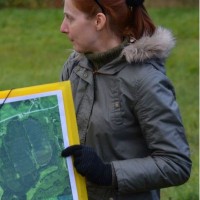
I work in the Nature Conservation Agency of Latvia. From time to time I am involved in different projects concerning nature conservation and research.

Luckily, in my life, I have never had a moment that I have not been convinced that music is the only thing that I want to do. I am a multi-instrumentalist with a basic specialization in percussion, composition and production.


